How to create Class diagram in MermaidJS
1. Install MermaidJS
You can install MermaidJS by including the MermaidJS library in your project or by installing it via npm.
2. Define the diagram
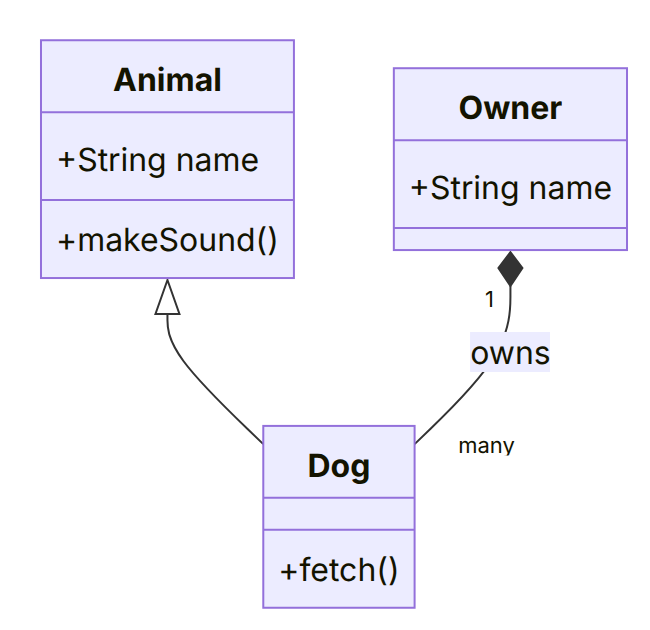
To create a class diagram, start the definition with classDiagram. Define each class with its attributes and methods inside curly braces, then connect classes with relationship arrows.
In this example, Dog inherits from Animal (empty triangle arrow), and one Owner owns many Dog instances via composition (filled diamond arrow).
3. Relationship types
MermaidJS class diagrams support the standard UML relationship arrows:
| Relationship | Syntax | Meaning | Preview |
|---|---|---|---|
| Inheritance | ClassA <|-- ClassB | ClassB is a subclass of ClassA | 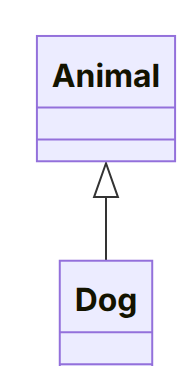 |
| Composition | ClassA *-- ClassB | ClassB cannot exist without ClassA (owns, filled diamond) | 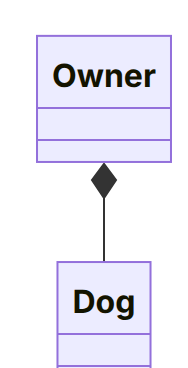 |
| Aggregation | ClassA o-- ClassB | ClassB can exist independently of ClassA (has-a, empty diamond) | 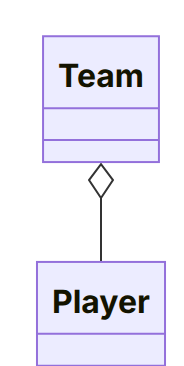 |
| Association | ClassA --> ClassB | ClassA uses or references ClassB | 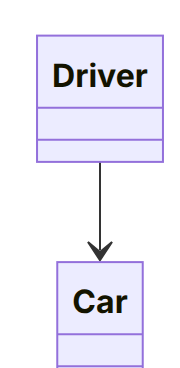 |
| Dependency | ClassA ..> ClassB | ClassA depends on ClassB (dashed arrow) | 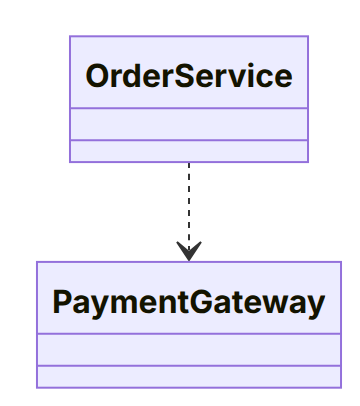 |
4. Visibility modifiers and multiplicity
Prefix attributes/methods with + (public), - (private), or # (protected). Add multiplicity labels like "1" or "many" next to a relationship, and an optional : label to name it, as shown in the Owner "1" *-- "many" Dog : owns line above.
5. Render the diagram
Once you have defined the diagram, you can render it on your webpage by including the MermaidJS library and calling the mermaid function with the diagram definition as a string. Here is an example of how to do this
You can use this MermaidJS Playground Link to explore that particular example.